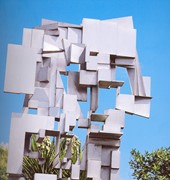
The Space Age
Electrical and Electronic Art in Greece 1957-1989
At Romanzo, Athens
It's been seventy years since the launch of the first artificial aisle, the Soviet Sputnik (Спутник-1, Sputnik 1). It was launched on October 4, 1957. Imagine there was a period that a child's most frequent answer to the question "What happens when you grow up?", was "I' ll be an astronaut". If this wakes you up nostalgia, you were probably born before the 1970s. If you were surprised, probably you were born a long time later. At some point in recent history, everyone, even the children, has turned into very 'landed' citizens. The cause of this mutation was not, of course, only the gradual decrease of space research, the fall of the Berlin Wall, the end of the Cold War, the end of modernism, the end of ideologies,... But maybe, all of this played a significant role in the final outcome of things.
Starting with the USA, the term "Space Age" has gone through both the popular literature and the bibliography as a term that coincides with time, is associated or even is identical to the term Atomic Age, a term which obviously at that time is determined by the atomic bomb in Hiroshima and the ensuing phobia of total destruction during the Cold War. Greece, of course, has never had a space programme, nor atomic or nuclear power, or related weapons. At the time when the space exploration race was at the very start of the two Cold War superpowers, Greece was trying to heal the wounds of the Civil War that had afflicted Greek people. However, as dozens of printed examples of the time testify, the tumultuous Greece shared the space vision as any country on the planet, rich or poor, on the left or right of the Iron Curtain. As in any other country, the standards of Astronaut/Cosmonaut, Spacecraft, Robot, and, shortly thereafter, Electronic Computers have been matched in scientific discussions, journalism, mass culture,...
A new art had to be created. The vision of a technological art will initially take the form of an electrical and then of an electronic art. If, internationally, experimentation of artworks that are combined with electricity will bear fruit already before World War II, with works such as those of Laszlo Moholy Nagy, in Greece this will take a long time. In fact, the first use of electricity in the Greek art will come from cinema projectors and from the expansion of instruments and microphones in light music. In the arts, a series of artists from the 1960s onward will earn the lost time at a fast pace.
The exhibition will explore the utopian applications and technologies of the future in the fields of Music (Xenakis, Logothetis, Christos, Magagakis, Adamis,...), Visual Arts (Takis, Pantelis Xagoraris, George Zongolopoulos, Costis (Triantafyllou), Minos Argyrakis,...), Cinema, Architecture and Urban Planning.
Works of
Minos Argyrakis, Takis, Pantelis Xagoraris, Valerios Kaloutsis, George Zongolopoulos, Thanasis Rentzis, Manthos Santorineos, Costis (Triantafyllou), Konstantinos Doxiadis, Yiannis Christou, Iannis Xenakis, Anestis Logothetis and others.
The exhibition will be accompanied by a book (edited by Konstantinos Vassiliou, Thanasis Moutsopoulos) from the Asini editions.
Organization: Euromare
Curator: Thanasis Moutsopoulos
Assistant Curator: Ilaria Boura
Architectural Department: Nikos Patsavos
Music Department: Nektarios Papadimitriou
Video Design Editor: Nefeli Dimitriadi
Exhibition design: Apostolos Panos
Location: Romanzo, 3-5 Anaxagora, Athens. Tel.: 2167003325
Opening: Thursday 22nd of June 2017, at 20.00
Duration: June 22 - September 10, 2017
Hours: Daily 18.00-23.00